Suffer in Silence No More: How Punk Is Finally Getting Real About Mental Health
There's an old joke that circulates in punk circles: therapy is for people who can afford to stop touring. It lands with a knowing laugh every time, which says everything about how deeply the culture has romanticized suffering. The van breaks down, you sleep on a stranger's floor, you play to eleven people in Tulsa, and you tell yourself that's the gig. That's the life. Complaining about it? That's for someone else's band.
But something is shifting. Quietly at first, then louder — because loud is kind of the whole point — musicians across the punk and hardcore spectrum are starting to talk openly about anxiety, depression, addiction, and the particular psychological toll that life on the road extracts from even the most seasoned performers. It's not a trend piece. It's not a PR moment. For a lot of these artists, it's a survival conversation that's arriving about twenty years too late.
The Mythology of the Tough Guy (And Why It's Exhausting)
Punk has always had a complicated relationship with vulnerability. On one hand, the entire genre was built on the idea of screaming the unspeakable into a microphone. On the other, there's a deep cultural suspicion of anything that looks like weakness — especially in the traditionally male-dominated spaces where hardcore and melodic punk have thrived.
"You're expected to be the tough one," says one touring guitarist who has been playing in bands for over fifteen years. "The second you say you're struggling, people either think you're fishing for attention or they quietly start wondering if you're reliable. It's a catch-22 that keeps a lot of guys from ever asking for help."
That silence has consequences. The statistics around mental health in the music industry are genuinely alarming — multiple studies have found that musicians are significantly more likely to experience depression and anxiety than the general population, with touring musicians facing compounded stressors: irregular sleep, poor nutrition, financial instability, social isolation, and the adrenaline crash that follows a high-energy performance night after night.
For punk bands operating on the DIY circuit — without label support, management, or tour managers — those pressures are amplified. You're booking your own shows, driving your own van, loading your own gear, and trying to maintain something resembling a personal life back home, all while performing at maximum intensity every single night.
The Therapist in the Green Room
A small but growing number of mental health professionals have started specifically working with touring musicians, and what they're hearing from their clients paints a vivid picture of an industry that has historically treated psychological distress as a rite of passage rather than a problem worth solving.
Dr. Cara Mendez, a licensed clinical psychologist based in Los Angeles who works with several touring artists, describes a pattern she sees repeatedly. "A lot of the musicians I work with initially come in thinking their anxiety or depression is just part of who they are as artists," she explains. "There's this narrative in music culture — and especially in punk — that the darkness is the source. That if you deal with it, you'll lose the edge. That's one of the most dangerous myths I encounter."
She points to the unique challenge of touring: the way it strips away ordinary coping mechanisms. Regular routines, home environments, stable relationships — the scaffolding most people rely on to maintain mental health — disappears the moment a band hits the road. What replaces it is often alcohol, because it's available everywhere and socially normalized in the venues where punk bands live and work.
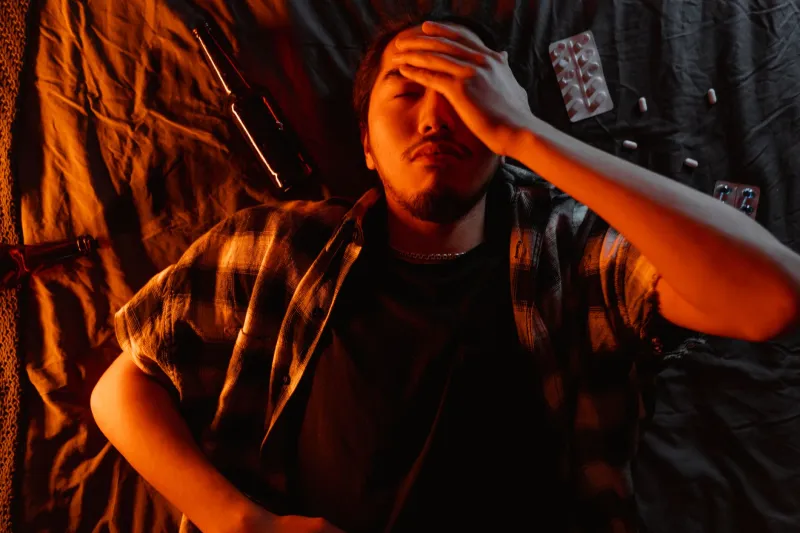
"Substance use in touring musicians isn't just recreational," Mendez says. "A lot of times it's self-medication. It's the only tool they have access to at 2 AM in a city they don't know, after a show that left them wired and emotionally raw."
Self-Care as a Radical Act
Here's where things get interesting — and genuinely punk, if you think about it.
The DIY ethos has always been about rejecting the systems that weren't built for you and building something better from scratch. In the '80s and '90s, that meant pressing your own records and booking your own tours because the industry wouldn't touch you. In 2024, for a growing number of artists, it means building mental health support into the infrastructure of how they operate — because the industry still won't do it for them.
Some bands are doing simple things: designating a sober driver who's also designated to check in on everyone emotionally. Building mandatory rest days into tour schedules. Creating explicit agreements about how the band handles it when someone is struggling. Others are going further — budgeting for telehealth therapy sessions the same way they budget for gas money, treating mental health maintenance as a line item rather than a luxury.
"I started seeing a therapist over video call while I was on the road," says one vocalist who plays in a Southern California punk band and asked to remain anonymous. "My bandmates thought it was weird at first. Now two of them do it too. You find a parking lot with decent WiFi and you just do it. It's not that complicated once you decide it matters."
That reframing — mental health as infrastructure, not indulgence — is the philosophical shift that seems to be gaining traction. It's not about going soft. It's about staying in the game long enough to matter.
The Conversation Is Getting Louder
Social media has played a complicated but ultimately useful role here. Punk has always been suspicious of platforms and algorithms — and rightfully so — but the same tools that can turn a band into a content machine have also allowed artists to speak directly to fans about struggles that would have once been considered off-brand.
When musicians with real followings post honestly about panic attacks before shows, about going to rehab, about the depression that followed the best tour of their lives, something happens in the comments. Other musicians recognize themselves. Fans recognize themselves. The mythology of the indestructible punk lifer starts to crack in ways that are actually humanizing rather than diminishing.
The bands that built this genre — Strung Out included — spent decades pouring genuine emotional devastation into their music. The songs were always about something real. It seems almost obvious in retrospect that the people writing those songs might need some help carrying that weight.
Still Loud, Just Honest
None of this means punk is getting soft. The music is still fast, still angry, still absolutely necessary. But there's a growing recognition that the culture around the music — the one that says you don't talk about it, you just push through — has been costing the scene some of its best people for a long time.
Burnout, breakdown, early exits from the road. Addiction that starts as a coping mechanism and ends careers. The quiet departures from bands that nobody fully explains. These aren't random tragedies. They're the predictable output of a culture that treats asking for help as weakness.
The new generation pushing back on that isn't betraying punk. They're doing exactly what punk has always done: looking at a broken system and deciding to build something better.
That's not a sellout. That's the whole point.